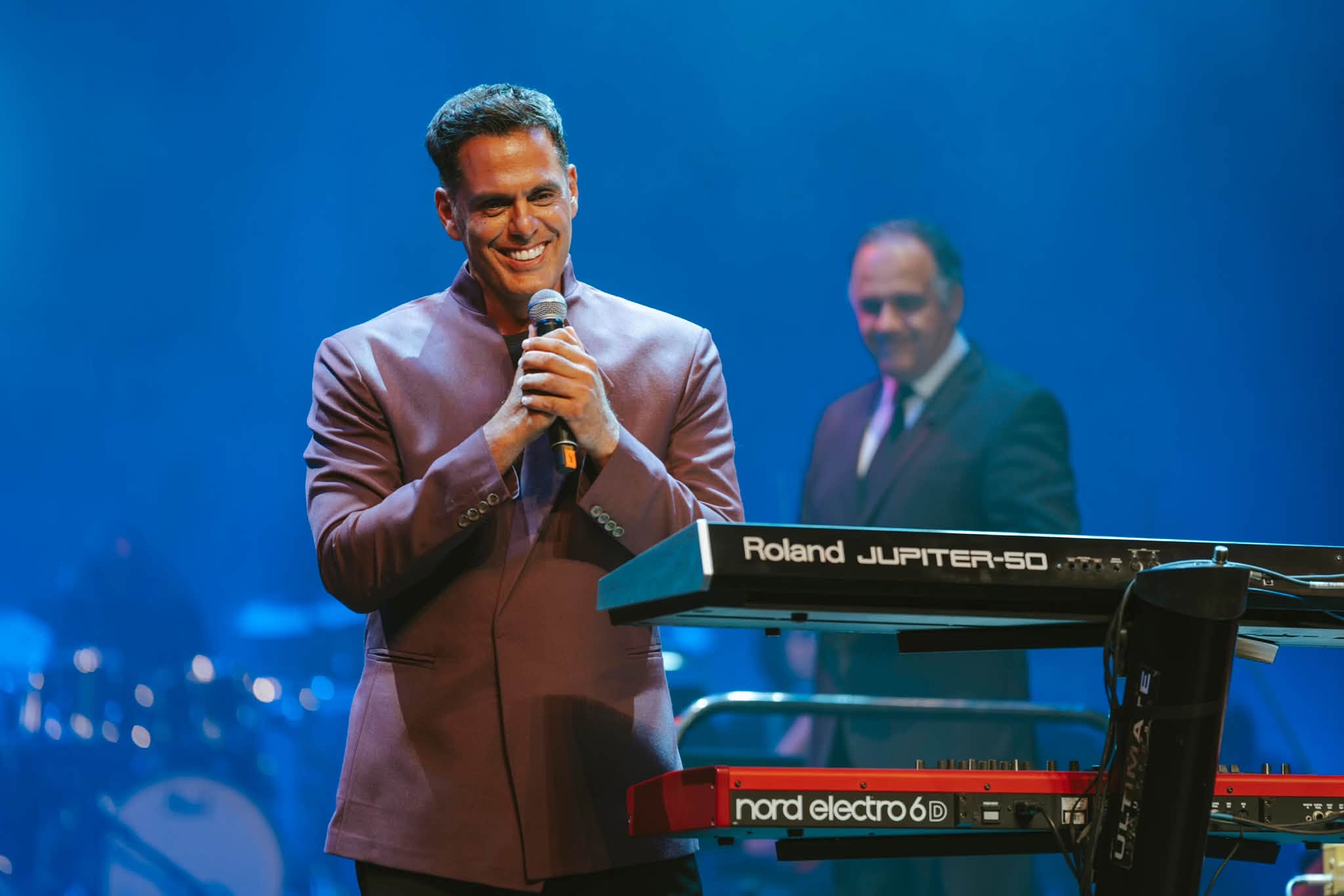
Egyptian composer and producer Hisham Kharma and maestro Nayer Nagui are bringing their work together onstage for the first time, the two concerts took place at the Bibliotheca Alexandrina on September 11 and the Cairo Opera House’s Grand Theater on September 18, with Nagui leading the orchestra.
Ahead of the performances, we caught up with Kharma and Nagui during rehearsals to talk about translating electronic compositions for an orchestra, revisiting earlier work, and what can happen when two musicians step into each other’s worlds.
The idea of bringing electronic music together with an orchestra has long held an appeal, the collaboration brought some of Hisham Kharma’s existing compositions a different life, with arrangements developed to bring out new details and possibilities in the music. It also opens up a different relationship with tempo and movement. While electronic production often works within the fixed tempo, an orchestra allows for more flexibility, with the musicians shaping the pace and dynamics in real time.
Classical music is often perceived as formal or inaccessible, Nayer Nagui notes, but orchestral instruments can be used in countless ways beyond their traditional settings. Having previously conducted orchestras alongside contemporary artists, he sees these cross-genre performances as an opportunity to bring different musical worlds into closer conversation.
That exchange is also central to how both musicians approach collaboration Kharma’s existing arrangements, the process involves entering one another’s creative worlds and finding something that neither would necessarily arrive at alone. For Kharma, the chemistry between the two has made the experience particularly rewarding.
One composition that takes on a new dimension in the orchestral setting is “El Bedaya,” one of Kharma’s earliest works. Originally built around solo instruments rather than an orchestral arrangement, the piece has since found a life of its own, becoming a familiar choice for wedding entrances. Hearing it reworked for a full orchestra brings a different scale and emotional weight to a composition that has already resonated with audiences.
The orchestra does more than reproduce the original recordings on a larger scale; it gives the compositions room to breathe, shift, and unfold differently in the moment. The result is a meeting of electronic production and orchestral performance that treats both as flexible musical languages, rather than opposing traditions.