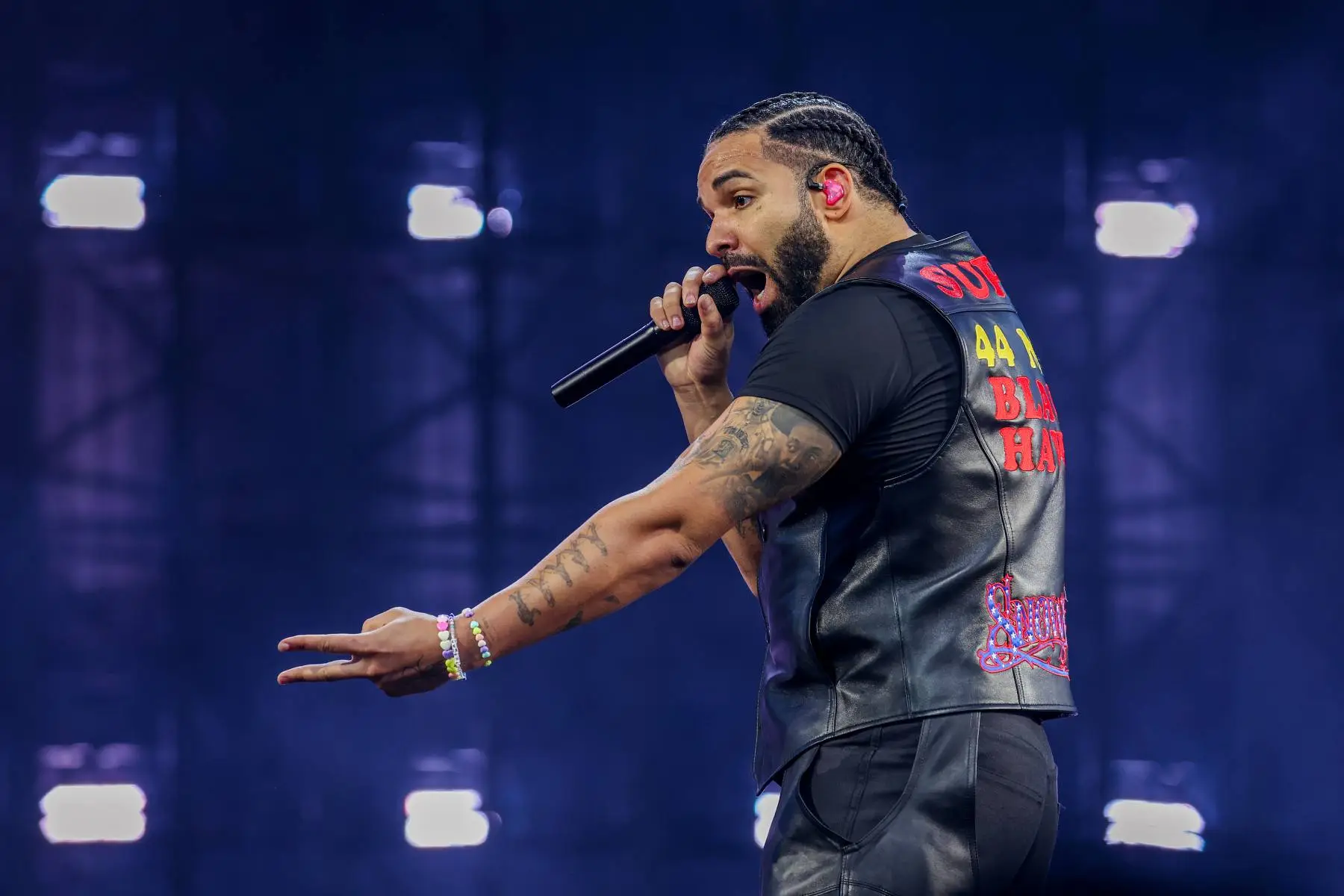
Seventeen minutes into Drake’s hour-long film FOMO, almost casually, comes the line: “Pray for Gaza.” At a time when even a few words from a major Western artist about Palestine can become a headline, a controversy, or a career risk, the moment carries a weight far greater than its length. It arrives not long after the backlash surrounding Macklemore’s decision to speak openly about Palestine, and it raises an increasingly difficult question: what does it actually mean when a famous musician acknowledges Gaza? Is being seen enough? Is being acknowledged enough? And when solidarity is reduced to a few words inside a song, a post, a concert, or a film, where does solidarity end and performance begin?
Silence is not necessarily preferable to speech, and public recognition can matter, particularly when artists have enormous audiences capable of amplifying an issue beyond the people already paying attention. Drake himself is not entirely new to the subject. He was an early signatory of the Artists4Ceasefire open letter in 2023, calling for an immediate de-escalation and ceasefire in Gaza. His longtime producer Noah “40” Shebib has also spoken publicly about the devastation he experienced watching the violence in Gaza, describing how he watched images and videos from the region with his father before his father died in November 2023. So the question is not simply whether Drake has ever expressed concern about Gaza. The question is what happens when an artist’s political expression appears in isolated moments, detached from any larger commitment, and whether audiences should treat those moments as activism in themselves.
There is also an ambiguity surrounding the “Pray for Gaza” line in FOMO. As journalist Shawn Setaro noted, the reference may have been intended literally, referring to Gaza in the Middle East, but it could also have been a reference to Vybz Kartel’s use of “Gaza” to describe Portmore, Jamaica, and the “Gaza Nation” associated with his music. Both interpretations are possible, and Drake’s history with dancehall makes the ambiguity relevant. That uncertainty itself says something about the difficulty of reading celebrity activism. When an artist makes a political statement directly, there is little room for interpretation. When the statement appears briefly inside a song, film, caption, or performance, audiences are left trying to determine what was intended, what was spontaneous, and what was carefully chosen.
That question becomes even more complicated when Drake’s recent lyrics are considered alongside the public discourse surrounding DJ Khaled. On Iceman, Drake raps, “Your people are still waitin’ for a Free Palestine. But apparently, everything isn’t black and white and red and green.” The line does not explicitly discuss Gaza or the war. Instead, it addresses Khaled, a Palestinian-American artist, in the context of their ongoing conflict. What makes the lyric uncomfortable is the way it can be interpreted as demanding that a Palestinian public figure demonstrate his Palestinian identity in a particular way. Khaled’s silence on Gaza has been criticized by some observers, especially because his public identity and career have been closely associated with his Palestinian and Arab heritage. But there is an important distinction between criticizing an artist’s public political silence and deciding that a Palestinian person has failed some test of Palestinian identity.
Solidarity then becomes another tool of policing: a Palestinian does not become Palestinian enough because they post the right infographic, say the right words, attend the right protest, or satisfy the political expectations of strangers online. Likewise, a non-Palestinian artist does not necessarily become a meaningful ally because they say “Free Palestine” once. The political value of speech depends partly on what comes with it, like: does the statement lead to education, fundraising, organizing, boycotts, institutional pressure, or sustained engagement? Or does it simply produce a moment of visibility before the artist returns to business as usual?
A repost, a hashtag, a black square, a temporary profile picture, or an aesthetically pleasing infographic can create the feeling of participation without necessarily creating meaningful change. Performative activism, aka slacktivism, is partly to gain social approval or the appearance of political commitment rather than because of a sustained investment in the cause itself.
Social movements depend on visibility, and social media can allow people without institutional power to circulate information that traditional media might ignore. The problem begins when visibility becomes the endpoint. An infographic can introduce someone to a subject. A song can make someone curious. A celebrity statement can bring millions of people into contact with an issue they had never considered. But none of those things necessarily constitutes the entirety of activism. They can be an entry point into activism, rather than activism itself.
Social media has become one of the major stages on which solidarity is performed. Fans circulate graphics, translate statements, organize hashtags, raise money, share fundraisers, boycott brands, and pressure celebrities – some of this work is genuinely consequential. During the humanitarian crisis in Gaza, fandom communities organized charity auctions, charity zines, gaming streams, and individual fundraising campaigns, with organizations such as the Palestinian Children’s Relief Fund and Medical Aid for Palestinians among those receiving support. Initiatives such as Gotcha for Gaza demonstrated that fandom communities can transform the infrastructure of fan culture into a fundraising mechanism.
In 2024, reporting on online Palestinian solidarity highlighted how some fans became more interested in determining which celebrity deserved praise or condemnation than in organizing around Palestine itself. Arguments erupted over whether a celebrity’s ceasefire pin was performative, whether another celebrity was sufficiently committed, whether someone had purchased from a particular company, or whether a favorite artist had associated with the “wrong” person. At a certain point, Palestine risks becoming the stage on which fans argue about their favorite celebrities rather than the reason they became politically engaged in the first place.
That is a particularly strange transformation because fandom already operates through intense emotional investment. Fans build identities around artists, develop parasocial relationships with them, spend money on them, defend them, and sometimes interpret the artist’s behavior as a reflection of themselves. Research on musician activism has repeatedly found that fans respond to political statements according to questions of identity, authenticity, emotional investment, and perceived shared values. When an artist says something that confirms a fan’s worldview, the statement can strengthen the relationship between artist and audience. When the artist challenges that worldview, the same relationship can become a source of conflict.
Musicians have been political for generations; we’ve seen Paul Robeson and Woody Guthrie use their platforms for labor and civil rights causes. Pete Seeger and Nina Simone performed and spoke during the civil rights era and the Vietnam War. The history of protest music demonstrates that music can do more than entertain; it can create collective identities, preserve political memory, communicate emotion, and give movements a language through which people understand themselves. Scholars have long debated how effective music actually is as political communication. Some have argued that protest songs largely preach to audiences who already agree with them, while others have described activist music as a form of “cognitive praxis” that helps social movements construct shared identities and frameworks for action.
The tension is therefore not between “music” and “politics” since music has always been political. The more interesting question is what happens when political expression enters a commercial system in which the artist is also a brand. The artist is speaking through an industry built around attention, image, consumption, and audience loyalty. Their political statement can become another piece of content. Their activism can become part of their personal brand.
This is why accusations of performativity are so powerful in celebrity culture. Audiences know that artists have marketing teams, publicists, managers, labels, sponsors, streaming platforms, and commercial interests. When an artist suddenly adopts a political cause, fans naturally ask whether the statement reflects a genuine commitment or a calculation about the audience they want to reach. Social media makes this suspicion even stronger because platforms reward content that generates engagement, outrage, and rapid emotional reactions. An artist who posts about Palestine may receive praise, criticism, new followers, lost followers, headlines, and increased engagement all at once. Speaking of which, Ed Sheeran reportedly lost 200,000 followers within 20 hours after releasing a statement about his supporting act being dropped from the tour after speaking about Palestine. In moments like these, the political message and the marketing ecosystem become almost impossible to separate.
Yet if every celebrity statement is automatically dismissed as performative, then the result can be a politics in which nobody is allowed to enter the conversation unless they have already demonstrated perfect commitment. That standard can be counterproductive, when people learn through exposure and awareness, artists can change their positions. Public figures can make mistakes, listen, educate themselves, and become more involved over time. The meaningful question is therefore not whether an artist’s first public statement is perfectly pure, but what follows it.
The contrast between symbolic solidarity and material action can be seen in the work of musicians and artists who have used their platforms to raise money, refuse performances, organize campaigns, or change institutional relationships. Artists have created merchandise and print sales with proceeds going to humanitarian organizations. Palestinian artist Jordan Nassar, for example, has used artwork and fundraising to support medical aid while emphasizing that fundraising is only one step toward political change. Other artists have organized print sales benefiting organizations supporting Palestinians, while artists such as Khaled Jarrar have used conceptual work to draw attention to land dispossession and support initiatives in Palestine. These actions demonstrate how art can move beyond representation and become a mechanism for directing resources and attention.
Campaigns such as Musicians for Palestine and No Music for Genocide have called on musicians to reconsider performances and institutional relationships. Artists have canceled or declined performances in Israel following appeals from Palestinian-led boycott movements, while others have publicly supported Palestinian rights. These actions are controversial, and artists have faced competing pressures from fans, governments, institutions, promoters, and other groups. But they demonstrate an important distinction: an artist can use their platform not only to say something but to give something up, redirect something, or change how their career operates.
That distinction becomes especially visible when an artist faces an actual professional cost for speaking. Macklemore’s recent experience illustrates the difference between a statement that disappears into the internet and a statement that creates consequences. After performing on the U.S. leg of Ed Sheeran’s tour, Macklemore told a stadium audience that he wanted to use the platform to say “Free Palestine.” Following criticism and controversy, he was removed from the remaining shows. Artists including Kneecap, Bob Vylan, Kehlani, Zara Larsson, Paloma Faith, Saul Williams, and others expressed support for him. Whatever one thinks of the particular controversy, the incident demonstrates why political speech from musicians can be materially different from a celebrity repost.
The history of musician activism is full of similar tensions; remember when The Chicks’ criticism of George W. Bush and the Iraq War in 2003 resulted in radio boycotts, backlash, death threats, and a major rupture with parts of their country-music audience. Rather than apologizing, the group released “Not Ready to Make Nice,” turning the backlash itself into part of their artistic response. Their story demonstrates that political activism can alter an artist’s relationship with their audience. It can cost something. But it can also create a different kind of community around shared values.
A concert is not simply a place where an artist performs songs but is a collective environment in which thousands of people experience the same sound, words, symbols, and emotions at the same time. Research into live music and collective behavior suggests that these environments can intensify emotional responses and create a sense of shared identity. A political message delivered from a stage can therefore become part of the memory of the concert itself. A Palestinian flag, a changed lyric, a spoken statement, or a call for donations can become more memorable because it occurs within a collective experience.
Green Day’s appearance at Coachella in 2025 provides one example of how this can happen. During the performance, the band displayed a Palestinian flag and altered a lyric in “Jesus of Suburbia” to reference Palestinian children. The moment circulated online and produced both praise and criticism. Whatever its ultimate political impact, it demonstrates the special symbolic power of the concert stage. A lyric that exists inside a song becomes something different when thousands of people hear it together, recognize the reference, and carry the image back onto social media.
But the question remains: what happens after the applause?
This is where fandom becomes important again. Fans are not powerless spectators. They are consumers, organizers, donors, voters, audiences, workers, and participants in the cultural economy that gives artists their influence. The “Fandoms for a Free Palestine” movement explicitly confronted this relationship, arguing that fans contribute directly to the financial and cultural production of the artists they love. Streaming a song, buying an album, attending a concert, purchasing merchandise, and promoting an artist all help maintain that artist’s influence. If fandom can create commercial value for artists, then fandom can also potentially use that collective power to demand accountability.
This has led fans to ask uncomfortable questions about whether they can continue consuming art from artists who remain silent, support opposing political positions, or participate in institutions they believe are complicit in oppression. Some have called for boycotts of corporations and cultural platforms, while others have pressured artists to cancel performances or publicly address Palestine. The debate can become intense because it forces people to confront something they would rather keep separate: loving art does not necessarily mean agreeing with the person who made it, but consuming art can still connect us to systems of money, power, and influence.
At the same time, fandom activism can become counterproductive when every disagreement turns into a celebrity loyalty test. Online arguments over whether one artist is sufficiently pro-Palestinian, whether another artist’s post is “performative,” or whether a fan is allowed to enjoy a particular song can consume enormous amounts of energy without changing anything outside the fandom itself. The movement becomes inward-facing. Instead of asking how to support Palestinians, people begin asking which celebrity deserves to be canceled.
That is perhaps the greatest danger of music slacktivism: not that people care too much, but that the attention economy teaches us to care about the wrong thing. A movement can become a stream of content. A genocide can become a trending topic. A celebrity can become a political proxy. A black square can become an identity badge. A “Free Palestine” lyric can become a marketing moment. A fandom can become an arena in which people demonstrate their own morality to one another.
And yet, dismissing all of this as meaningless would also be a mistake.
Art matters precisely because people remember through stories, images, songs, performances, and symbols. Music can cross language barriers and social divisions in ways that political speeches often cannot. A child can learn about biodiversity through a song. A protest can become memorable because people sing together. A movement can find its emotional vocabulary in music. The purpose of art is not always to provide a policy solution. Sometimes its purpose is to make people feel something they were previously able to ignore.
The problem begins when feeling becomes the destination.
If a song about Palestine makes someone curious, that curiosity can become education. Education can become conversation. Conversation can become organizing. Organizing can become fundraising, political pressure, boycotts, mutual aid, protest, or other forms of collective action. In that sense, the song matters. The celebrity statement matters. The Instagram story matters. The concert speech matters. But they matter as part of a chain, not as the chain itself.
This is also why the question of authenticity is more complicated than simply asking whether an artist “really cares.” We cannot know the private motivations behind every public statement. A person can have mixed motives and still produce a meaningful action. An artist can care deeply and still have a marketing department. An artist can make a political statement that benefits their career and simultaneously benefit a cause. Human motivations are rarely pure enough to fit neatly into the categories of “genuine” and “performative.”
What can be evaluated more concretely is what the artist actually does. Do they continue speaking when the issue is no longer trending? Do they use their platform to direct people toward reliable information? Do they raise money? Do they change professional decisions? Do they accept criticism? Do they educate themselves? Do they make room for Palestinian artists rather than simply speaking over them? Do they recognize that Palestinians are not props in someone else’s celebrity narrative? Do they allow the cause to remain about Palestinians rather than turning it into a story about themselves?
These questions also apply to fans.
The responsibility of a fan is not necessarily to become a full-time activist. Nor is every person who reposts a fundraiser required to become an organizer. But there is a difference between participating imperfectly and treating participation itself as the achievement. Sharing something can be the first step. It should not necessarily be the last. Before reposting, learn what you are sharing. Before repeating a statistic, verify it. Before attacking someone, understand what you are attacking. Before turning a political cause into a fandom war, ask whether the argument is actually helping the people whose suffering supposedly motivated it.
The internet has made political participation incredibly accessible, but accessibility can create the illusion that clicking is equivalent to organizing. It is not. A petition can matter, but signing it without understanding the demand is different from organizing people around it. A fundraiser can matter, but sharing a fundraiser is different from raising money. A concert speech can matter, but a speech does not substitute for material support. A celebrity can bring attention to a cause, but attention itself does not end a war.
There is also an ethical danger in turning Palestinians into a test of whether celebrities are sufficiently political. Palestinians are not an audience waiting for Western musicians to perform solidarity correctly. Palestinian artists, writers, musicians, filmmakers, and fans have their own voices, histories, and creative traditions. When Western celebrity culture makes itself the center of the conversation, the people supposedly being supported can disappear from the story.
Perhaps that is the most important distinction between solidarity and slacktivism. Slacktivism asks, “What did I post?” Solidarity asks, “What changed?” Slacktivism asks, “Did people see that I care?” Solidarity asks, “Did this help someone?” Slacktivism asks whether the celebrity said the correct thing. Solidarity asks what resources, attention, money, access, or power can actually be redirected toward the people affected.
Saying “Pray for Gaza” can be meaningful. Singing “Free Palestine” can be meaningful. Putting a Palestinian flag on a stage can be meaningful. But the meaning becomes deeper when the gesture connects to something beyond the moment. When art becomes a bridge to education, when a performance raises money, when a celebrity uses their access to amplify Palestinian voices, when fans move from streaming to organizing, or when an artist accepts a professional cost rather than retreating at the first sign of controversy, the relationship between art and activism becomes harder to dismiss as mere performance.
The challenge, then, is not to demand that musicians save the world. It is to stop confusing visibility with change.
So when Drake says “Pray for Gaza,” the question does not have to be whether the words are good enough. The more useful question is what comes next. When Macklemore says “Free Palestine” from a stadium stage, the question is not simply whether we agree with him. It is what happens when an artist is willing to attach consequences to those words. When fans fill timelines with Palestinian flags, fundraisers, and infographics, the question is not whether those posts count as activism. The question is whether the attention they generate moves somewhere beyond the screen.
Because in an age of genocide, attention is abundant. We have never had more ways to tell the world that we care. We can post, repost, stream, hashtag, comment, perform, trend, cancel, defend, and argue almost endlessly. What is harder is turning that attention into sustained action.
Not whether artists speak, but whether they keep speaking when the algorithm moves on. Not whether fans can prove that they support Palestine, but whether their support reaches beyond their fandom. Not whether a celebrity can wear the costume of solidarity, but whether they are willing to do something that cannot simply be removed when the trend ends.